


Next: Free Vibrations of Ideal Systems: Up: Lumped System Analysis: Previous: Lumped System Analysis:

 , the frequency-independent damping constant.
 .
.

 , where C is a complex constant, the corresponding force can be found by differentiation as:
 .
.
 .
.
 : the force always leads velocity by a 1/4 cycle.
 . A constant DC force produces an infinite velocity output, while a force of infinite frequency results in zero velocity (the mass resists high-frequency motion). The phase is
  : the velocity always lags the applied force by 1/4 cycle.
 for x(0) = 0 (valid for small, non-distorting displacements)
, where C is a complex constant, the corresponding force can be found by integration as:
 .
.
 .
.
: the restoring force always lags velocity by a 1/4 cycle.
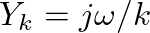 . A constant DC force implies a zero velocity output, while a force of infinite frequency results in an infinite velocity. The phase is : the velocity always leads the restoring force by 1/4 cycle.
 .
.

 of velocity, which corresponds to transferring a unit of momentum to the mass at time 0, with a resulting velocity v(t) = 1/m.

| ©2004-2024 McGill University. All Rights Reserved. Maintained by Gary P. Scavone. |


