Next: Cylindrical Air Column Acoustics Up: Acoustic Systems Previous: The Wave Equation for Plane
 and
and  , respectively, then the enclosed air has a mass of
  , where
  is the mass density of air.
 . Using Newton's second law (force = mass
  acceleration),
where
acceleration),
where
 is the acoustic volume velocity of the air mass.
 so that Eq. (7) reduces to
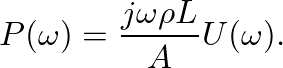 (8)
(8)
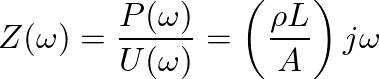 (9)
(9)
 when expressed in terms of the Laplace transform), where initial conditions are assumed equal to zero.
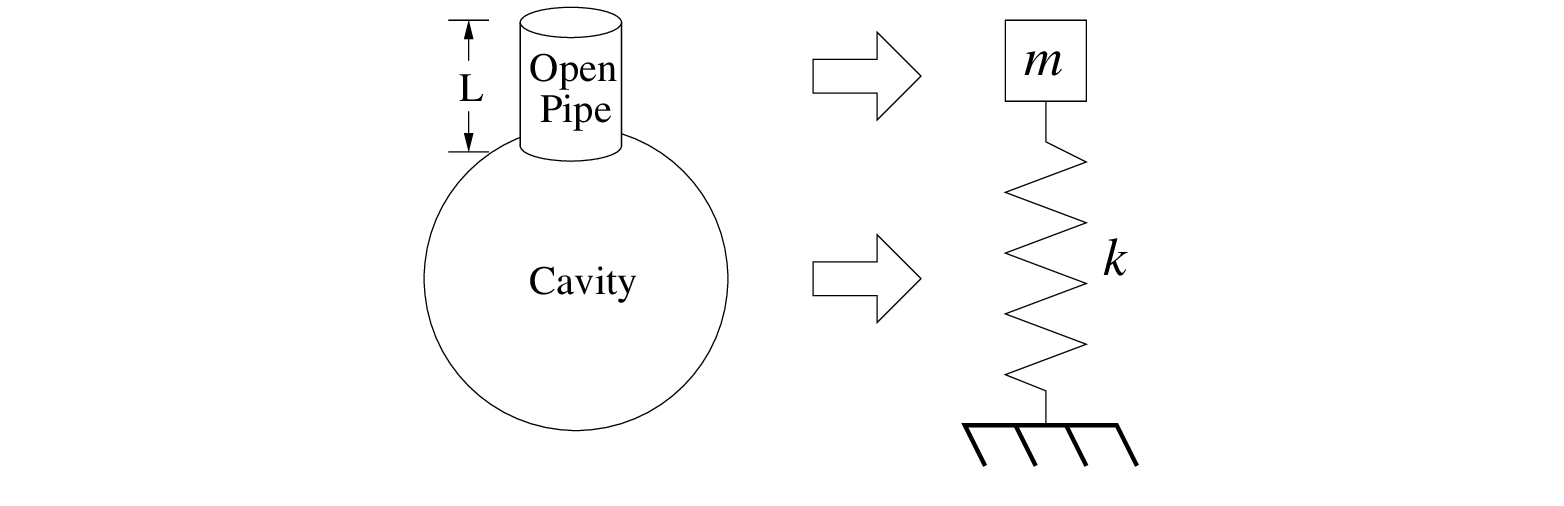
 and thus the open tube has an equivalent acoustic “mass” equal to
  An inertance is also sometimes referred to as a constriction (Morse, 1981, p. 234).
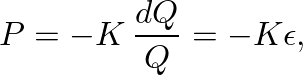
 an increase in applied pressure
  will decrease this volume by an amount
  .
.
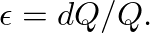 Using Hooke's law, we find
where
Using Hooke's law, we find
where  is the bulk modulus as discussed earlier.
, in terms of the sinusoidal volume velocity  as
as
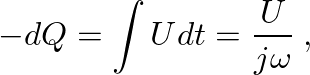 (11)
(11)
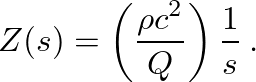 (12)
(12)
 so by analogy the acoustic cavity has an equivalent “spring constant” equal to
 , where
  is the speed of sound in air, is the cross-sectional area of the tube, is the length of the tube, and
  is the volume of the cavity.

| ©2004-2024 McGill University. All Rights Reserved. Maintained by Gary P. Scavone. |