Next: Finite Length Cones Up: Conical Air Column Acoustics Previous: Conical Bores: Modes of Propagation
 and
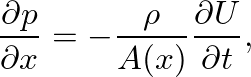
and  in which case Eq. (2) reduces to a general solution of the form
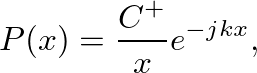 (3)
(3)
 is a constant and
  is the wave number in open air. Waves of this type will propagate at all frequencies.
 in a finite length conic section is composed of superposed spherical traveling-wave components of the form
where and
in a finite length conic section is composed of superposed spherical traveling-wave components of the form
where and  are complex amplitudes and sinusoidal time dependence is assumed.
 is the surface area of a spherical cap that intersects the principal axis of the pipe at position .
 |
 |
![$\displaystyle \frac{A(x)}{x \rho c}\left[C^{+}\left(1 + \frac{1}{jkx}\right)e^{-jkx} -C^{-}\left(1 - \frac{1}{jkx}\right)e^{jkx}\right]e^{j\omega t},$](img42.png) |
|
|
![$\displaystyle \frac{1}{x} \left[\frac{C^{+}}{Z_{c}(x)}e^{-jkx} - \frac{C^{-}}{Z_{c}^{*}(x)}e^{jkx}\right] e^{j\omega t}.$](img43.png) |
(6) |
and frequency 
 or the complex conjugate of
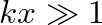 , the spherical wave fronts become more planar in shape and
  approaches
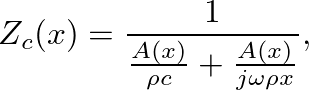
 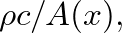 the wave impedance for plane waves in a duct of cross section
becomes increasingly dominant and in the limit as
 the pressure and velocity traveling-wave components become
  out of phase at the cone tip.
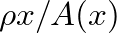 .
.

| ©2004-2024 McGill University. All Rights Reserved. Maintained by Gary P. Scavone. |
![$\displaystyle P(x,t) = \left[\frac{C^{+}}{x}e^{-jkx} + \frac{C^{-}}{x}e^{jkx}\right] e^{j\omega t},
$](img36.png)