Next: Modeling Approaches Up: Synthesizing Conical Instrument Sounds Previous: The Equivalent Circuit
 are shown to vary with respect to the parameter
  as depicted in Fig. 15.
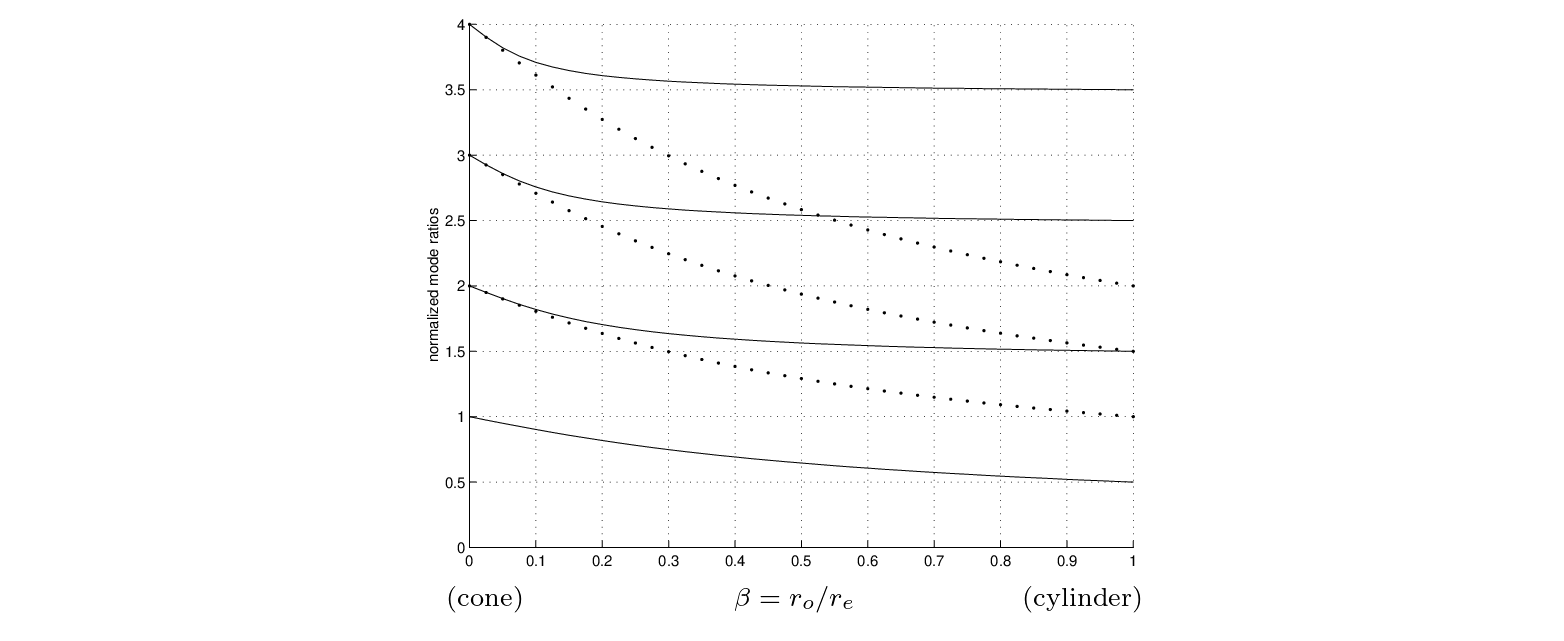 |
can be defined in terms of the ratio of input to output end radii,  , or in terms of the ratio
 , where
  is the length of the missing, truncated apical section (see Fig. 13).
 , while a closed-open cylinder is given by
  .
.
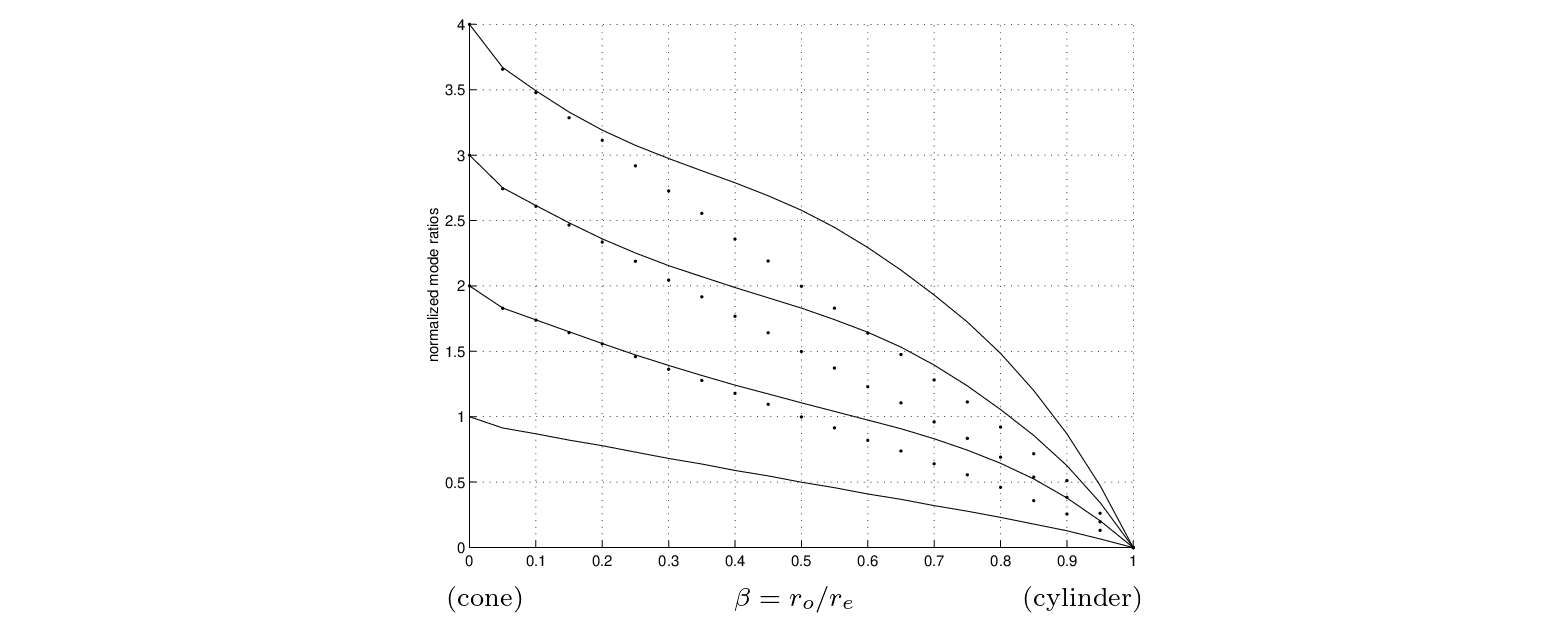 |
, the structure is of infinite length and all its modes converge to zero. In comparison with Fig. 15, the compound horn displays nearly harmonic mode ratios out to values of in the range 0.2–0.3.
 , in the equivalent circuit (Fig. 14). The inertance, whose magnitude varies with the parameter , tends to “shunt” low-frequency wave components, thus imposing a “high-pass” characteristic on the resulting air column mode structure.

| ©2004-2024 McGill University. All Rights Reserved. Maintained by Gary P. Scavone. |