Next: Filters in Matlab Up: Discrete-Time Signals & Digital Filtering Previous: Steady State and Transient Response
 -Transform
-transform is a mathematical tool that is extensively used to evaluate the properties of discrete-time systems such as digital filters. In particular, it is convenient for determining the stability of a system. It is the discrete-time equivalent of the Laplace transform, which is used for continuous-time systems.
-Transform of a discrete-time signal ![$x[n]$](img15.png) is given by:
is given by:
![$\displaystyle X(z) \ensuremath{\stackrel{\Delta}{=}}\sum_{n = 0}^{+\infty} x[n] z^{-n},
$](img46.png) is a complex variable.
is a complex variable.
-transform maps a discrete-time signal to a function of the complex variable .
-transform is given by the Shift Theorem,
![$\displaystyle x[n - \Delta] \leftrightarrow z^{-\Delta} X(z),
$](img47.png)
 samples in the time domain corresponds to a multiplication by
  in the domain.
-transform of a digital filter's difference equation. Given the following second-order difference equation,
![$\displaystyle y[n] = b_0 x[n] + b_1 x[n-1] + b_2 x[n-2] - a_1 y[n-1] - a_2 y[n-2],
$](img49.png) -transform can immediately be written (assuming the system is linear)
-transform can immediately be written (assuming the system is linear)

 , of the filter:

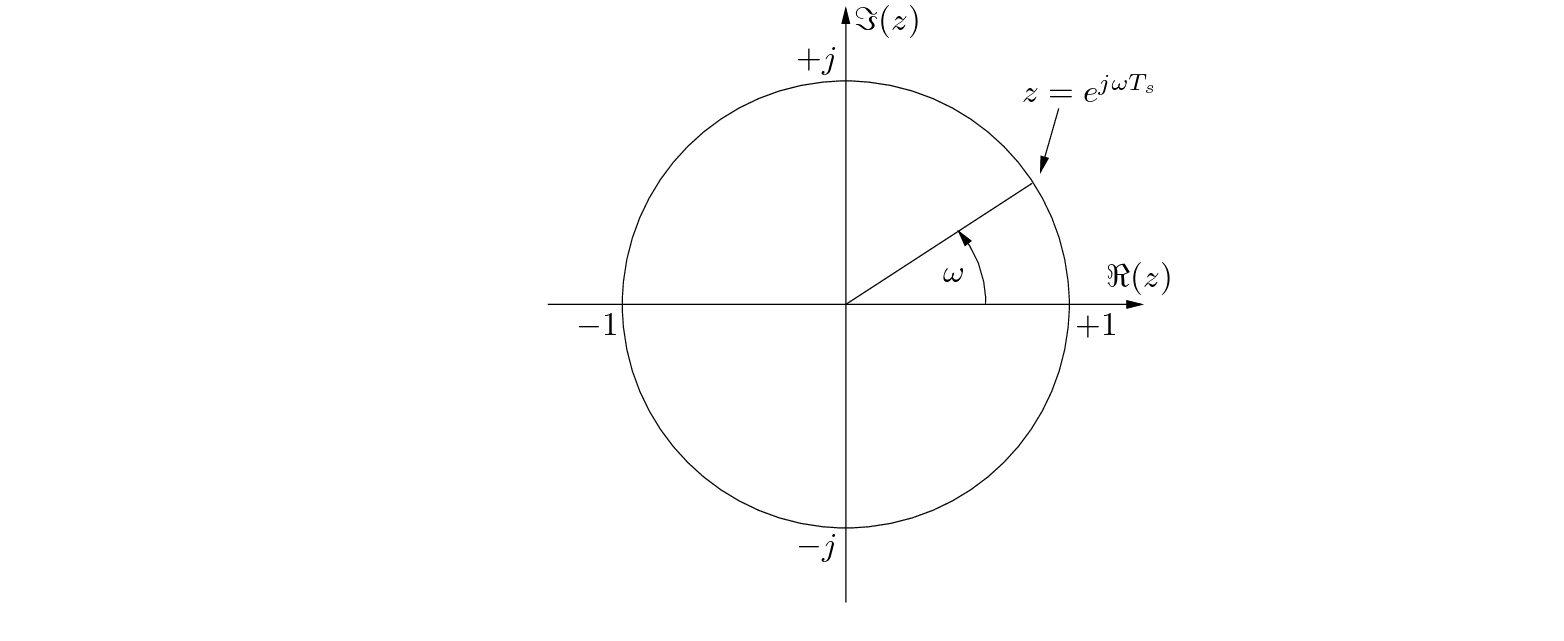
-plane, as illustrated below:
-transform is a more general version of the Discrete-Time Fourier Transform, which itself can be viewed as the limiting form of the DFT when its length  is allowed to approach infinity.
-transform by setting
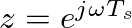 , where
  is in radians per second and
  is the sample period. In the complex -plane, this is equivalent to evaluating the -transform on the “unit circle” defined by
.
is the sample period. In the complex -plane, this is equivalent to evaluating the -transform on the “unit circle” defined by
.

| ©2004-2026 McGill University. All Rights Reserved. Maintained by Gary P. Scavone. |